Pages

Showing posts with label inspiration. Show all posts

Tuesday, 15 May 2012

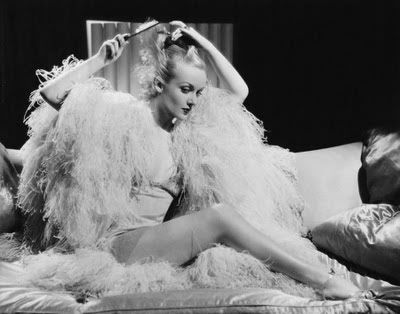
Old Hollywood Inspiration: Carole Lombard

Carole Lombard was born Jane Alice Peters in Fort Wayne, Indiana, on October 6, 1908. Her parents divorced in 1916 and her mother took the family on a trip out West. While there they decided to settle down in the Los Angeles area. After being spotted playing baseball in the street with the neighborhood boys by a film director, Carole was signed to a one-picture contract in 1921 when she was 12.
The film in question was A Perfect Crime (1921). Although she tried for other acting jobs, she would not be seen onscreen again for four years. She returned to a normal life, going to school and participating in athletics, excelling in track and field. By age 15 she had had enough of school, though, and quit. She joined a theater troupe and played in several stage shows, which were for the most part nothing to write home about. In 1925 she passed a screen test and was signed to a contract with Fox Films.
Her first role as a Fox player was Hearts and Spurs (1925), in which she had the lead. Right after that film she appeared in a western called Durand of the Bad Lands (1925). She rounded out 1925 in the comedy Marriage in Transit (1925) (she also appeared in a number of two-reel shorts). In 1926 Carole was seriously injured in an automobile accident that resulted in the left side of her face being scarred. Once she had recovered, Fox canceled her contract. She did find work in a number of shorts during 1928 (13 of them, many for slapstick comedy director Mack Sennett), but did go back for a one-time shot with Fox called Me, Gangster (1928). By now the film industry was moving from the silent era to "talkies". While some stars' careers ended because of heavy accents, poor diction or a voice unsuitable to sound, Carole's light, breezy, sexy voice enabled her to transition smoothly during this period.
Her first sound film was Wanted (1929) at Pathe (her new studio) in 1929. In 1931 she was teamed with William Powell in Man of the World (1931). She and Powell hit it off and soon married, but the marriage didn't work out and they divorced in 1933. No Man of Her Own (1932) put Carole opposite Clark Gable for the first and only time (they married seven years later in 1939). By now she was with Paramount Pictures and was one of its top stars. However, it was Twentieth Century (1934) that showed her true comedic talents and proved to the world what a fine actress she really was. In 1936 Carole received her only Oscar nomination for Best Actress for My Man Godfrey (1936). She was superb as ditzy heiress Irene Bullock. Unfortunately, the coveted award went to Luise Rainer in The Great Ziegfeld (1936), which also won for Best Picture.
Carole was now putting out about one film a year of her own choosing, because she wanted whatever role she picked to be a good one. She was adept at picking just the right part, which wasn't surprising as she was smart enough to see through the good-ol'-boy syndrome of the studio moguls. She commanded and received what was one of the top salaries in the business - at one time it was reported she was making $35,000 a week. She made but one film in 1941, Mr. & Mrs. Smith (1941). Her last film was in 1942, when she played Maria Tura opposite Jack Benny in To Be or Not to Be (1942). Tragically, she didn't live to see its release.
The film was completed in 1941 just at the time the US entered World War II, and was subsequently held back for release until 1942. Meanwhile, Carole went home to Indiana for a war bond rally. On January 16, 1942, Carole, her mother, and 20 other people were flying back to California when the plane went down outside of Las Vegas, Nevada. All aboard perished. The highly acclaimed actress was dead at the age of 33 and few have been able to match her talents since.

Biography: Taken from Imdb
Photos: Taken from here

Tuesday, 8 May 2012

Old Hollywood Inspiration: Mae West

Mary Jane West was born in Brooklyn, New York, on August 17, 1893, to parents involved in prizefighting and vaudeville. Mae herself worked on the stage and in vaudeville from the time she was five years old. She never was academically inclined because she was too busy performing. She studied dance as a child, and by the time she was 14 she was billed as "The Baby Vamp" for her performances on stage.
Later Mae began writing her own plays. One of those plays, "Sex", landed her in jail for ten days on obscenity charges in 1926. Two years later her play "Diamond Lil" became a huge Broadway success. Mae caught the attention of the Hollywood studios and was given her first movie role with George Raft in Night After Night (1932). Although it was a small role, she was able to display a wit that was to make her world-famous. Raft himself said of Mae, "She stole everything but the cameras." She became a box-office smash hit, breaking all sorts of attendance records.
Her second film, She Done Him Wrong (1933), was based on her earlier and popular play that she had written herself. The film was nominated for an Academy Award as Best Picture. It also made Cary Grant a star. Her third film later that year was I'm No Angel (1933). The controversy aroused by these two films resulted in the studios establishing the Motion Picture Production Code, which regulated what content could be shown or said in pictures. As a result of these codes, Mae began to double-talk so that a person could take a word or phrase any way they wished. This was so she could get her material past the censors, and it worked.
She really felt she had a vested interest because it was her written work being scrutinized. She had already written and performed these for the stage with the very material now being filmed. Her next film, Belle of the Nineties (1934), was an equal hit. By 1936, with Klondike Annie (1936) and Go West Young Man (1936) she became the highest paid woman in the US. After 1937's Every Day's a Holiday (1937), she didn't make another film until 1940, when she co-starred with W.C. Fields in another film she wrote herself, My Little Chickadee (1940). It was well known she had little use for Fields and his ways, which were crude even for her.
After Tropicana (1943), Mae took a respite from the film world, mainly because the censors were getting stricter. She decided she would be able to have greater expression in her work if she went back to the stage. Mae continued to be a success there. When censorship began to end in the 1960s, she returned to film work in 1970's Myra Breckinridge (1970). Her last film was 1978's Sextette (1978). Mae suffered a series of strokes which finally resulted in her death at age 87 on November 22, 1980, in Hollywood, California.
She was buried in New York. The actress, who only appeared in 12 films in 46 years, had a powerful impact on us. There was no doubt she was way ahead of her time with her sexual innuendos and how she made fun of a puritanical society. She did a lot to bring it out of the closet and perhaps we should be grateful for that.

Biography: Taken from Imdb
Photos: Taken from here

Thursday, 3 May 2012

Pencil Skirt Inspiration

Prior to starting my pencil skirt this week, I gathered up a bunch of images from the 1950's & 1960's as inspiration. So sit back, and enjoy the next few images!
Source

Source

Source

Source

Source

Source

Source


Tuesday, 1 May 2012

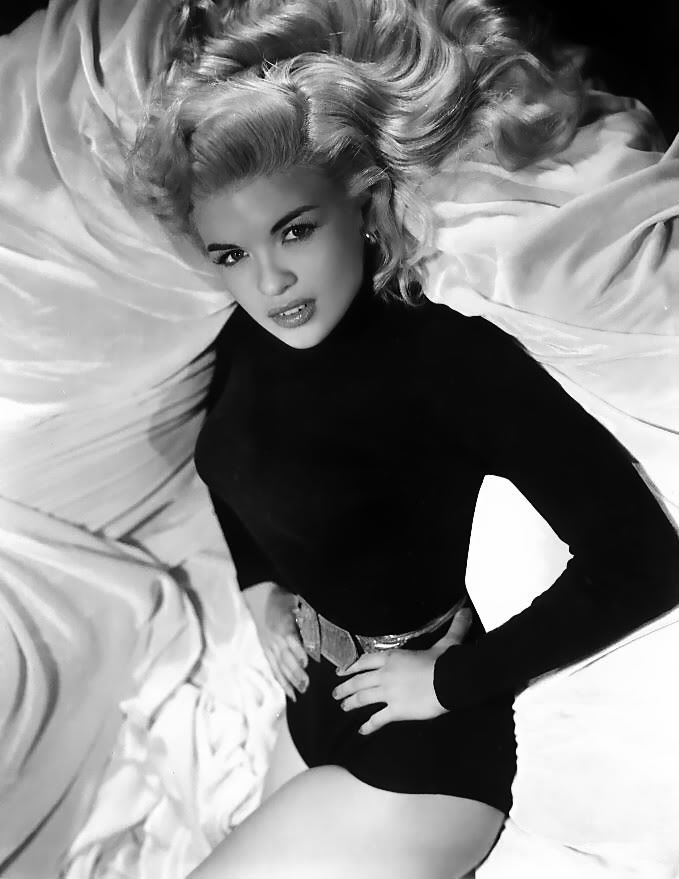
Old Hollywood Inspiration: Jayne Mansfield

One of the leading sex symbols of the 1950's 1960's and movie and B movie actress, Jayne Mansfield was born in Pennsylvania on Wednesday, 19 April 1933 and as a child she was a talented pianist and violin player.
Amazingly her IQ was reported to be a 163 and she attended the University of Dallas and participated in little-theatre productions. In 1949 at age 16 she married a man 8 years her senior named Paul Mansfield the next year when Jayne Mansfield was 17 the two had a child named Jayne Marie Mansfield. She landed a small but sexy role in Pete Kelly's Blues (1955), which led to roles that were more prominent in several ways also when she started her movie career she played in movies with popular actors and actresses to help kick start her movie career.
A job in the Broadway production of "Will Success Spoil Rock Hunter?" brought her a good deal of attention for her scantily clad appearance, and she repeated the role in the film version with CoStar Tony Randall (A actor who would later on CoStar in a movie with Marilyn Monroe in 1960 called "Let's Make Love"). Her high-pitched squeal of delight and the studied ease with which she flaunted her more than obvious pulchritude led to a succession of roles as sex kittens and dumb blonde bombshells. She occasionally appeared in films of some quality, but though she apparently aspired to respectability as an actress, her public persona was too extreme to be taken seriously, and she became a sort of poor man's 'Marilyn Monroe' or as the backup or second star for Marilyn Monroe, without the vulnerability and ability that Monroe possessed also the popular movie studios did not think she was that much of a dumb blonde because she knew her movies lines easily.
In the early 1960's she began affairs with many famous individuals like 35th President JFK and his younger brother RFK. By the 1960s Mansfield's career had options that grew lower. She made somewhat embarrassing guest appearances like on the 1950's popular game show "What's My Line?" she appeared on the show 4 times 1956, 1957, 1964, and 1966 and many other 1950's and 1960's game shows also by 1962 she was dropped from 20th Century Fox and the rest of her career had smaller options like being in B movies and low budget movies or performing at food stores or small nightclubs.
On June 29, 1967, Jayne was killed when the car in which she was riding crashed into the back of a semi on the road near Slidell, Louisiana. Her lawyer Sam Brody also perished in the accident. The beautiful woman who starred in 31 movies, the woman who fought so hard for respectability, the woman who, in her own right, was a very good actress was dead at the age of 34. Her final film, Single Room Furnished (1968) was released the following year.

Biography: Taken from Imdb
Photos: Taken from here

Tuesday, 24 April 2012

Old Hollywood Inspiration: Olivia De Havilland

Olivia Mary de Havilland was born to a British patent attorney and his wife on July 1, 1916, in Tokyo, Japan. Her sister, Joan, later to become famous as Joan Fontaine, was born the following year. Her parents divorced when Olivia was just three years old, and she moved with her mother and sister to Saratoga, California.
After graduating from high school, where she fell prey to the acting bug, Olivia enrolled in Mills College in Oakland. It was while she was at Mills that she participated in the school play "A Midsummer Night's Dream" and was spotted by Max Reinhardt. She so impressed Reinhardt that he picked her up for both his stage version and, later, the Warner Bros. film version in 1935.
She again was so impressive that Warner executives signed her to a seven-year contract. No sooner had the ink dried on the contract than Olivia appeared in three more films: The Irish in Us (1935), Alibi Ike (1935) and Captain Blood (1935), the latter with the man with whom her career would be most closely identified, heartthrob Errol Flynn. He and Olivia starred together in eight films during their careers.
In 1939 Warner Bros. loaned her to David O. Selznick for the classic Gone with the Wind (1939). Playing the sweet Melanie Hamilton, Olivia received her first nomination for an Academy Award for Best Supporting Actress, only to lose out to one of her co-stars in the film, Hattie McDaniel. After GWTW, Olivia returned to Warner Bros. and continued to churn out films.
In 1941 she played Emmy Brown in Hold Back the Dawn (1941), which resulted in her second Oscar nomination, this time for Best Actress. Again she lost, this time to her sister Joan for her role in Suspicion (1941). After that strong showing, Olivia now demanded better, more substantial roles than the "sweet young thing" slot into which Warners had been fitting her. The studio responded by placing her on a six-month suspension, all of the studios at the time operating under the policy that players were nothing more than property to do with as they saw fit.
As if that weren't bad enough, when her contract with Warners was up, she was told that she would have to make up the time lost because of the suspension. Irate, she sued the studio, and for the length of the court battle she didn't appear in a single film. The result, however, was worth it. In a landmark decision, the court said not only that Olivia did not have to make up the time, but that all performers were to be limited to a seven-year contract that would include any suspensions handed down. This became known as the "de Havilland decision"; no longer could studios treat their performers as mere cattle.
Returning to screen in 1946, Olivia made up for lost time by appearing in four films, one of which finally won her the Oscar that had so long eluded her. It was To Each His Own (1946), in which she played Josephine Norris to the delight of critics and audiences alike. Olivia was the strongest performer in Hollywood for the balance of the 1940s. In 1948 she turned in another strong showing in The Snake Pit (1948) as Virginia Cunningham, a woman suffering a mental breakdown. The end result was another Oscar nomination for Best Actress, but she lost to Jane Wyman in Johnny Belinda (1948).
As in the two previous years, she made only one film in 1949, but she again won a nomination and the Academy Award for Best Actress for The Heiress (1949). After a three-year hiatus, Olivia returned to star in My Cousin Rachel (1952). From that point on, she made few appearances on the screen but was seen on Broadway and in some television shows. Her last screen appearance was in The Fifth Musketeer (1979), and her last career appearance was in the TV movie The Woman He Loved (1988) (TV). During the hoopla surrounding the 50th anniversary of GWTW in 1989, she graciously declined requests for all interviews as the only surviving one of the four main stars. Today she enjoys a quiet retirement in Paris, France.

Biography taken from Imdb
Images taken from here

Wednesday, 18 April 2012

Spring & Summer Palette Challenge - Fabrics & Patterns

After making my moodboard I started to go through my patterns for some inspiration, and see if I could match any up with the fabrics I have.
So for the patterns I have the following as possible candidates.

Tops

My tried and tested blouse patterns, although it's my birthday next month and I have asked for some Colette Patterns, so fingers crossed for a Violet or a Sencha to join the above!

Bottoms
I need some new skirts for work, so the Butterick and the 1970's McCalls are ideal, I also really want to make another playsuit but I'm not sure about this pattern? I want more of a 1940's style like the ones Q's Daydream has just debuted here.

Dresses
A lot of options for dresses, although that didn't really come as much of a surprise to me! The vintage vogue pattern is actually intended for a 1950's theme night I'm attending in July.

Now obviously, I'm not intending on making everything listed above, this is of course just an idea of what I could make.

Now for fabrics -

Blue

Top: Embroidered Silk, very small amount, maybe 1/2 metre?
Middle: Butchers Stripe Heavy Cotton, again very small amount, possibly 1/2 metre
Bottom: Floral Georgette, 4 metres

Orange

Top: Polyester Crepe with Orange/Blue squares, 3 metres
Middle: African Wax Cotton, 2 metres (I think?!)
Bottom: Pheasant Printed Georgette, 3 metres

Mustard

Drill Cotton, roughly 2 metres.

Burgundy


Polyester Suiting (I believe?), 2 metres.

At this moment I own nothing that's of a khaki/beige colour so this is what I'm keeping an eye out for next.
Any suggestions on what would work well together?